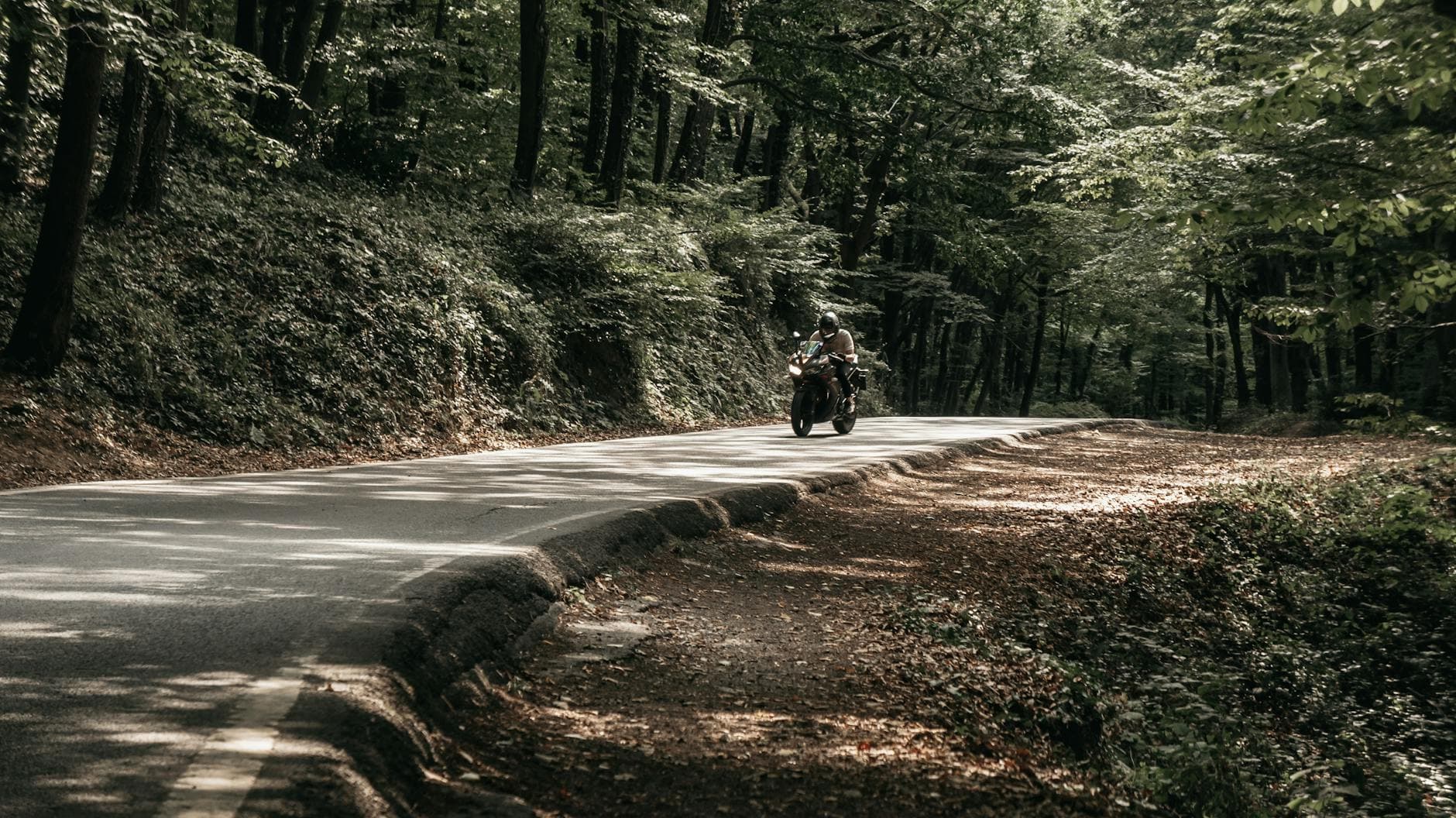
 Photo: Ikbal Alahmad / Pexels / Pexels License
France — France
French Jura by Motorcycle: Col de la Faucille, the Loue Gorges and the Hérisson Waterfalls
Key highlights
- Col de la Faucille at about 1,323m, with Lake Geneva and Mont Blanc below
- The high Jura around Les Rousses, Morez and Saint-Claude
- Cascades du Hérisson and the cliff-ringed valley of Baume-les-Messieurs
- Arbois and Château-Chalon, the home of vin jaune
- The Loue gorges from the river’s source down to Ornans
The Jura is the long, curving mountain range along the French–Swiss border, between Geneva and Basel. It is lower than the Alps, with its tops between 1,300 and 1,700 metres, but it is big, empty country: high pastures, dark fir forests, deep limestone gorges and lakes, with very few large towns. For riders it offers mile after mile of quiet, well-surfaced roads, a handful of real passes, and a food culture built around Comté cheese and the region's unusual wines. It is also on the direct route from the Channel ports and northern France to Geneva and the Alps, which makes it the perfect two-day stop on the way south.
Planning a Jura trip
For this route, base yourself in the high Jura around Les Rousses or Morez on the first night, and in Arbois, Ornans or Salins-les-Bains on the second. Riders from the north usually arrive via Besançon or Dijon; riders from Switzerland via Geneva or the crossing at Vallorbe.
Day one: Faucille, the high Jura and Saint-Claude (about 170km)
Gex to the Col de la Faucille (about 12km). Start at Gex, just north of Geneva, and climb the D1005 to the Col de la Faucille. The climb is about 10 kilometres of steady bends and hairpins up the steep eastern face of the Jura, and from the top, at about 1,323 metres, Lake Geneva and the Alps fill the view, with Mont Blanc behind on a clear day. There is a viewpoint just below the col on the way up.
Faucille to Les Rousses and Morez (about 30km). Over the top, the road drops through Mijoux and the high Valserine valley, then crosses wide pastures and fir forest to Les Rousses, a small resort by a lake. Morez, in a deep valley below, is the French capital of spectacle-making, and the road down into it is a fine run of bends.
Morez to Saint-Claude (about 30km). Ride south through the gorges of the Bienne to Saint-Claude, a town of pipe makers and diamond cutters squeezed into a narrow valley. The roads around it climb steeply out of the gorges in every direction.
Saint-Claude to the Lac de Vouglans and the Hérisson (about 100km). Head north-west to the Lac de Vouglans, a long reservoir in a wooded valley, with roads that follow its shores and cross it on high bridges. Then ride north to the Cascades du Hérisson, a chain of waterfalls in a forested gorge near the Jura lakes. The walk to the main falls takes an hour or more there and back; boots are fine for the first ones.
Day two: Baume-les-Messieurs, Arbois and the Loue (about 210km)
Baume-les-Messieurs (about 40km). West of the lakes, the plateau ends in a series of deep blind valleys, called reculées, ringed with cliffs. The finest is at Baume-les-Messieurs, where an abbey sits in the valley floor beneath 200-metre limestone walls. The roads down into the reculée and back out are steep and twisting, and the viewpoint at the top of the cliff is one of the best in the Jura.
Château-Chalon and Arbois (about 40km). Ride north along the edge of the plateau to Château-Chalon, a hilltop village above the vineyards that gives its name to a vin jaune, the Jura's distinctive yellow wine, and on to Arbois, the wine capital of the Jura and the town where Louis Pasteur grew up.
Salins-les-Bains to the source of the Loue (about 50km). From Arbois, ride to Salins-les-Bains, an old salt-making town in a narrow valley, then climb east across the plateau. Near Ouhans, the Loue river springs fully formed from a cave at the foot of a cliff. A short walk from the car park takes you to the source.
The Loue gorges to Ornans (about 30km). From the source, the road follows the Loue downstream through Mouthier-Haute-Pierre and a deep gorge to Lods and Ornans, a town of old houses built over the river, home of the painter Gustave Courbet. This is the scenic highlight of the day: a winding valley road with cliffs above and the river below, and a series of viewpoints over the gorge.
Extensions (about 50km and up). East of the Loue, the Château de Joux guards a gorge near Pontarlier, and the Lac de Saint-Point is a large natural lake with a road round its shores. To the south, the Route des Sapins winds through the great fir forest of La Joux near Champagnole.
The roads
Jura roads are generally well surfaced and lightly used, but they are mountain roads: shaded gorges stay damp, gravel collects on the hairpins, and cows and tractors use the pasture roads. Weather changes fast on the high plateau, and the Faucille and the high Jura can be under snow from November to April. The descent of the Faucille toward Gex is steep and busy with commuters from Geneva on weekdays.
When to go
May to October. June brings flowering meadows on the high pastures; September and October bring autumn colour in the beech woods and the end of the summer crowds at the lakes. The Jura is noticeably colder than the plains around it, so pack a warm layer even in summer.
Riding in France
Gloves are compulsory for motorcyclists in France, and helmets must carry reflective stickers. Most two-lane country roads are limited to 80km/h, though some departments have restored 90km/h on certain roads. Check our riding in France page before you go.
Food and stops
The Jura's food is mountain food. Comté, the hard cheese made from the milk of the cows you ride past all day, is sold at village fruitières (cooperative dairies), many of which welcome visitors. Morteau sausage, smoked in tall chimneys, and Mont d'Or, a soft cheese eaten warm in winter, are the other local specialities. In Arbois and the villages around it, the wine estates offer tastings of vin jaune and the region's other wines: save them for the evening.
Where to stay
Les Rousses or Morez for the high Jura, Arbois, Ornans or Salins-les-Bains for the second night. See our France biker hotels. The Jura links naturally with the Vosges Route des Crêtes to the north and the French Alps to the south.